
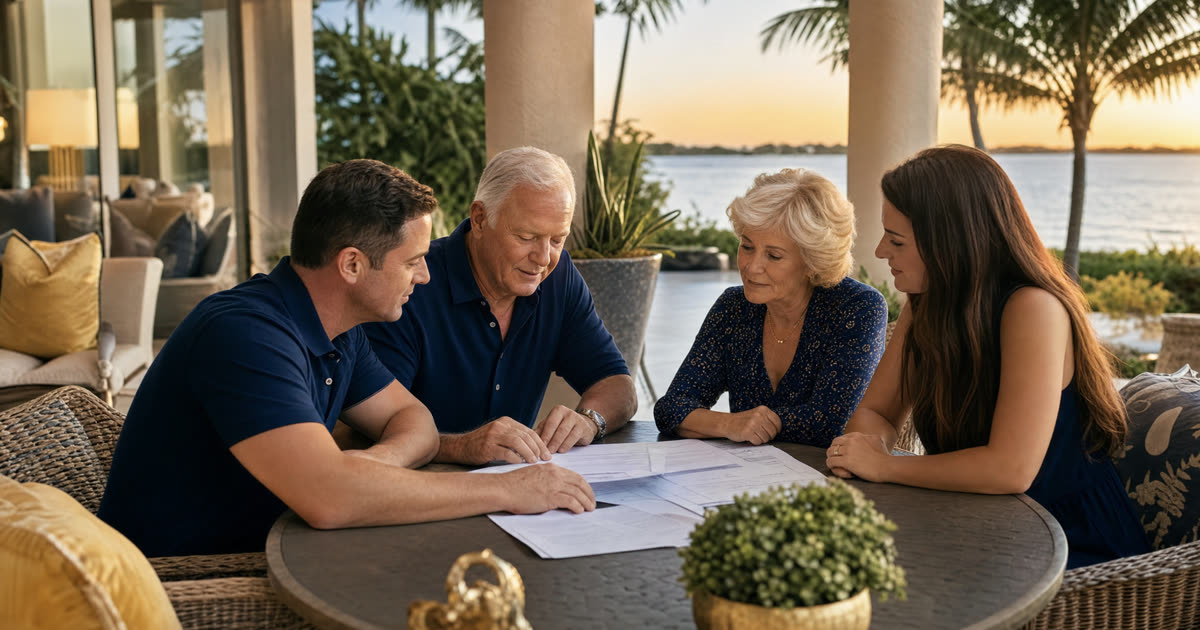
Steve and Maria's Trust: A Common Florida Story
Steve and Maria are a composite couple I use to illustrate a question that comes up more often than people expect. In 2019, while still married and living in Orlando, they set up an irrevocable trust and funded it for the benefit of their two children. Maybe it held a life insurance policy, maybe it held a chunk of savings or a piece of investment real estate. Now, in 2026, they are divorcing, and one of the first things their attorneys are asking is whether that trust is still theirs to divide, or whether it belongs to the kids and is off the table.
An irrevocable trust is one that the person who created it cannot simply revoke or change on their own. That is precisely what allows assets inside it to move outside the reach of the settlor's estate, and in some situations outside the reach of the settlor's creditors. The question in a divorce like Steve and Maria's is whether that same feature keeps the trust out of equitable distribution.
Have this exact situation? Talk it through with a Florida attorney — the 20-minute consultation is free.
Book Free Consult or call (888) 388-8445Is a Completed Gift to the Trust Still Marital Property?
Florida is an equitable distribution state, meaning the court divides marital assets and liabilities fairly, though not necessarily equally, when a marriage ends. Property acquired during the marriage is generally treated as marital, subject to some exceptions. So the natural question is whether money Steve and Maria earned during the marriage, then moved into an irrevocable trust for their children, is still 'marital' even after it left their names.
The general answer is that a completed gift to an irrevocable trust, made while both spouses were married and (ideally) both aware of and agreeing to the transfer, is no longer an asset either spouse owns. Once the money or property was irrevocably transferred to the trustee for the children's benefit, it left the marital estate in the same way a completed gift to any third party would. The court cannot award Maria a trust asset that legally belongs to the trust for the children, and it cannot order the trustee to hand it back to either parent.
That does not mean the transfer is beyond scrutiny. It only means that, absent some problem with how or when it was made, the trust corpus itself is generally not divided in the divorce.
Could the Transfer Be Challenged as Dissipation?
This is where Steve and Maria's situation gets more interesting, and where a divorcing spouse's attorney will look closely at timing. Florida law allows a court to depart from an even division of marital assets when one spouse has intentionally dissipated, wasted, depleted, or destroyed marital assets, particularly within roughly the two years before the divorce petition was filed, or after filing. This is sometimes called the dissipation doctrine, and Florida courts have applied it even when the dissipated funds ended up in an irrevocable trust rather than simply spent or hidden.
If Steve and Maria funded their trust in 2019 and did not divorce until years later, that timing generally works in their favor: a transfer made well outside any lookback window, for a legitimate purpose like providing for the children's education, is far less likely to be recast as dissipation than a transfer made on the eve of filing. But if a similarly situated couple funded a trust shortly before or during a pending divorce, particularly without the other spouse's knowledge or consent, a court could credit the value of that transfer back to the transferring spouse's side of the ledger, effectively treating the trust funding as if the money were still in that spouse's pocket for purposes of dividing everything else.
What If a Spouse Is Also a Trustee or Beneficiary?
Suppose Steve, not Maria, was named sole trustee of the children's trust, with authority to make distributions for their education and health. That trusteeship is a role, not an asset. The divorce court does not award or divide it the way it divides a bank account, but it can absolutely become a contested issue: Maria's attorney may ask whether Steve should remain the sole decision-maker for the children's trust once the marriage ends, or whether a co-trustee, a corporate trustee, or a trust protector should be added for balance and accountability going forward.
The analysis changes if either spouse was named a beneficiary of the trust, rather than just a trustee. This is less common in a trust drafted purely for children, but it happens, for example, if the trust allows distributions to a spouse for support during the marriage. Florida has a clear rule for revocable trusts: divorce automatically voids provisions benefiting a former spouse unless the trust or the divorce judgment says otherwise. Florida has not enacted an equivalent automatic rule for irrevocable trusts. That means a former spouse named as a beneficiary of an irrevocable trust may keep that beneficial interest after the divorce unless the trust document itself contains a clause addressing divorce, or unless the trust is modified. This is one of the more overlooked risks in irrevocable trust planning, and it is exactly why an attorney drafting a family trust during a marriage should build in a provision that suspends or removes a spouse's beneficial interest automatically if a divorce is filed.
Can the Trust Be Changed After the Divorce?
Once Steve and Maria's divorce is final, neither of them can simply revoke the children's trust; that is the nature of an irrevocable trust under the Florida Trust Code, Chapter 736. But 'irrevocable' does not mean 'frozen forever.' Florida law gives several paths to adjust an irrevocable trust when circumstances change, including divorce:
- A nonjudicial settlement agreement among the trustee and beneficiaries, if the change does not violate a material purpose of the trust.
- Judicial modification, asking a court to approve changes because of circumstances the original settlors did not anticipate.
- Decanting under Florida's trust decanting statute, which allows a trustee with appropriate discretion to pour the assets of an existing irrevocable trust into a new trust with modified terms.
- A trust protector, if one was named in the original document, who may have express authority to amend administrative provisions or trustee succession.
- Modification with the consent of the settlor (or settlors) and all beneficiaries, where all interested parties agree.
For Steve and Maria, this means that even though the trust for their children cannot be unwound or divided as part of the divorce, it is not necessarily locked in exactly its 2019 form for the next several decades. If circumstances warrant, such as one parent's remarriage, a need for a different trustee, or a change in one child's needs, the trust may be adjustable through one of these routes, with the children's protected interest remaining the fixed point around which any changes are built.
The Children's Interest Stays Protected Either Way
Whatever else is contested in Steve and Maria's divorce, the trust they built for their children generally is not treated as a bargaining chip between the parents. A properly drafted irrevocable trust for the benefit of children, funded with a completed gift, holds an interest that belongs to those children, not to either parent individually. A spendthrift provision, if the trust includes one, adds a further layer of protection by shielding the children's interest from most creditors while the assets remain in trust, though once money is actually distributed out to a beneficiary, it becomes that person's own property and loses that shield.
This is often the most reassuring part of the conversation for divorcing parents. The very feature that makes an irrevocable trust harder to unwind, the fact that neither Steve nor Maria can simply reach back in and take the money out, is also what keeps that trust functioning as intended for the children through a divorce, a remarriage, or whatever else follows.
Frequently Asked Questions
The Truestead Takeaway
Steve and Maria's situation, as I have sketched it here as a composite and not an actual client, is the clean version of a common Florida divorce issue: money that was truly and completely gifted into an irrevocable trust for the children years before any divorce was on the horizon generally stays outside the marital estate, protected for the kids regardless of what happens between the parents. The harder version of this question comes up when the funding was recent, when one spouse did not fully understand or consent to it, or when a spouse still holds a trustee role or beneficial interest that needs to be addressed as part of the settlement. If you funded an irrevocable trust during your marriage and are now facing a divorce, or if you are still deciding whether to create one, the sensible next step is to have both the trust document and the timing of any transfers reviewed by a Florida attorney who can look at your specific facts alongside your family law counsel.
Sources
- Alper Law, "Can a Trust Protect Assets in a Florida Divorce? Irrevocable Trust Protection," April 23, 2026
- Alper Law, "Asset Protection in a Florida Divorce: Marital Property, Exemptions, and Divorce Obligations," April 23, 2026
- Pazos Law Group, "Trusts and Divorce in Florida: Beneficial Interests," May 15, 2026
- Jacksonville Estate Planning Attorney, "Revocable Trusts and Divorce: Managing Living Trusts When a Marriage Ends in Florida," May 27, 2025
- Streets Law, "Florida Divorce: Equitable Distribution and Irrevocable Trusts," discussing Collier v. Collier (Fla. 1st DCA), July 28, 2022
- Rafool, PLLC, "Miami Equitable Distribution of Trusts in Florida Divorce," discussing Nelson v. Nelson (Fla. 2d DCA, December 16, 2016)
Have a child turning 18? Get the free 18 & Protected packet — the legal documents every Florida 18-year-old needs.
Get the Free PacketTalk to a Florida Attorney
Every family’s situation is different. Schedule a consultation with Arthur Simpson, Esq. to review your plan and your options under Florida law.
Schedule a Consultation →This article is for general informational purposes only and does not constitute legal advice, nor does reading it create an attorney-client relationship. Florida estate, elder, probate, and real estate law are fact-specific and change over time. Consult a licensed Florida attorney about your individual circumstances. Arthur Simpson, Esq. is licensed to practice law in the State of Florida. Attorney advertising.
Talk to a Florida Attorney — Free 20-Minute Consultation
Pick a time below. No obligation, no pressure — just answers.