
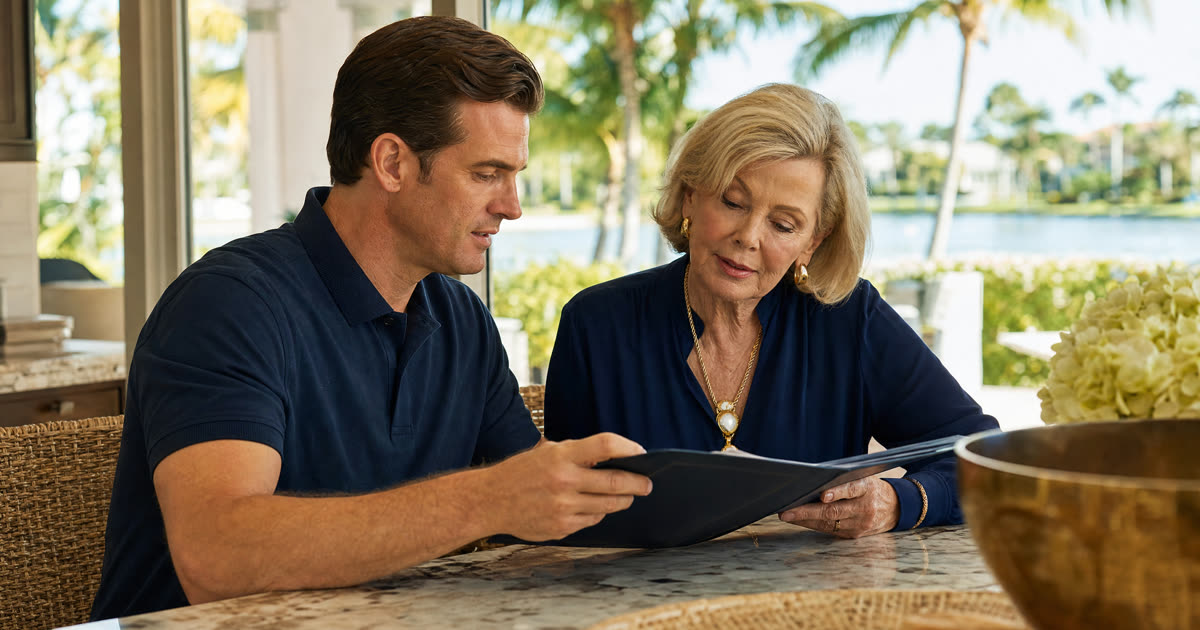
Frank and June: a family in the lucky position of having time
Frank is 83. June is 81. They live in Port St. Lucie in a house they paid off years ago, and they have about $500,000 between savings and investment accounts. Neither of them has needed a hospital stay in years. Their last estate planning documents were signed in 2009. Frank and June are a composite I'm using to illustrate common patterns, not an actual Truestead client, but their situation is one I see often: two parents who are fine today, adult children who are starting to wonder about tomorrow, and a stack of outdated paperwork nobody has looked at in over a decade.
This is, honestly, the best possible moment to plan. Not because anything is wrong, but because nothing is wrong yet. Florida's Medicaid rules reward people who plan ahead of a crisis far more than people who plan during one. Here is the checklist I'd walk a family like Frank and June's through.
Have this exact situation? Talk it through with a Florida attorney — the 20-minute consultation is free.
Book Free Consult or call (888) 388-8445Start with the documents, while both parents can still sign
Before anything involving trusts or asset transfers, the paperwork has to work. A 2009 power of attorney and healthcare directive were drafted under an older statute, and Florida's current law on powers of attorney (Chapter 709, Florida Statutes) is specific about what an agent can and cannot do.
One detail trips up a lot of families: if a power of attorney doesn't separately authorize gifting, the agent generally cannot make gifts on the principal's behalf, even small ones, even to help qualify for benefits later. Florida law requires that gifting authority be specifically enumerated and separately signed or initialed. A general, boilerplate POA from 2009 almost certainly does not do this.
For Frank and June, that means updating their durable powers of attorney with gifting powers built in, along with their healthcare surrogate designations and living wills, is the first task, not an afterthought. It has to happen while both of them have capacity to sign. Capacity is not a formality here. Once someone cannot understand and sign a document, the window closes, and the family is left asking a court for guardianship instead, which is slower, more public, and more expensive than simply updating the paperwork now.
The five-year clock, and whether a trust fits people who don't yet need one
Florida Medicaid looks back five years from the date of application to review transfers of assets. Gifts or uncompensated transfers inside that window can create a penalty period of ineligibility. The flip side is the opportunity: money moved into an irrevocable trust more than five years before an application is generally outside the look-back and outside the countable asset calculation altogether.
This is where Frank and June's situation gets interesting. They don't need to protect everything, and I would never recommend a healthy couple hand over their entire $500,000 to an irrevocable arrangement. But a partial Medicaid Asset Protection Trust, funded now with a portion of savings they genuinely don't need for daily living, starts the five-year clock while both of them are well. If neither of them needs care for five years, that money is simply protected, quietly, in the background. If one of them needs care sooner, the trust didn't help with Medicaid timing, but it hasn't hurt anything either, and the family still has every other planning tool available.
The IRA question nobody asks until it's too late
Retirement accounts get overlooked in this conversation constantly, and they shouldn't. How an IRA or 401(k) is titled, and whether it's already in payout status, affects how it's treated if one spouse later needs nursing home care and applies for Medicaid.
For a married couple, Florida's Medicaid rules generally allow a retirement account to be treated more favorably if it's already generating regular required distributions, because income is handled differently than a lump sum of countable assets. This is a conversation Frank and June should have with their financial advisor and attorney together, now, while they can review beneficiary designations, required distribution status, and whether any change makes sense, rather than scrambling to figure it out after a hospital stay has already started a countdown.
The house and a Lady Bird deed
The home is usually a family's largest asset and, for a married couple living in it, it's also typically an exempt resource for Medicaid eligibility purposes regardless of value, as long as one spouse continues to reside there. The bigger long-term question for Frank and June is not current eligibility, it's what happens to the house after both of them have passed, and whether the state has a claim against it through Medicaid estate recovery.
An enhanced life estate deed, commonly called a Lady Bird deed in Florida practice, lets a homeowner keep full control of the property during their lifetime, including the right to sell it or change their mind, while naming who receives it automatically at death, outside of probate. Families often look at this tool specifically because it can help address estate recovery exposure on the home without giving up any control today. Whether it's the right fit depends on the family's full picture, including whether a trust is already being used for other assets, and it's worth reviewing with a Florida attorney who can confirm how it interacts with everything else Frank and June put in place.
Long-term care insurance at 81 and 83
I get this question from adult children constantly: should Mom and Dad just buy long-term care insurance now, while they're healthy? It's worth asking an insurance professional, but by the early-to-mid eighties, traditional long-term care policies are often expensive relative to the benefit, and some insurers set age limits that make new policies hard to find at all. It doesn't hurt to ask, but for most families in Frank and June's position, the planning tools above, documents, a partial trust, retirement account review, and the deed, end up doing more realistic work than a new insurance policy would at this age.
The conversation Frank and June had with their kids
The planning only works if the family talks about it. In this composite scenario, Frank and June sat down with their adult children and walked through, in plain terms, where the documents were kept, who held healthcare and financial power of attorney, what the partial trust was for, and why they were comfortable giving up control of that portion of their savings in exchange for protecting it. Nobody likes rehearsing what happens if a parent gets sick. But the alternative, adult children discovering outdated documents and no shared understanding during an actual hospitalization, is harder on everyone, and it tends to happen at the worst possible moment.
Frequently Asked Questions
The Truestead Takeaway
Frank and June did not wait for a diagnosis to plan, and that timing is the entire point of this article. Updated powers of attorney while both parents have capacity, a serious look at whether a partial irrevocable trust makes sense for savings they can spare, a review of how retirement accounts are titled, and a Lady Bird deed conversation about the house are all things a healthy couple in their eighties can do calmly, on their own schedule, with their children in the room. None of it requires a crisis to start. If your own parents are in a similar window right now, both doing fine, documents years out of date, the honest next step is a sit-down with a Florida elder law attorney who can look at the whole picture and tell you which of these tools actually fits your family, because waiting costs something too, even when nothing happens while you wait.
Have a child turning 18? Get the free 18 & Protected packet — the legal documents every Florida 18-year-old needs.
Get the Free PacketTalk to a Florida Attorney
Every family’s situation is different. Schedule a consultation with Arthur Simpson, Esq. to review your plan and your options under Florida law.
Schedule a Consultation →This article is for general informational purposes only and does not constitute legal advice, nor does reading it create an attorney-client relationship. Florida estate, elder, probate, and real estate law are fact-specific and change over time. Consult a licensed Florida attorney about your individual circumstances. Arthur Simpson, Esq. is licensed to practice law in the State of Florida. Attorney advertising.
Talk to a Florida Attorney — Free 20-Minute Consultation
Pick a time below. No obligation, no pressure — just answers.